
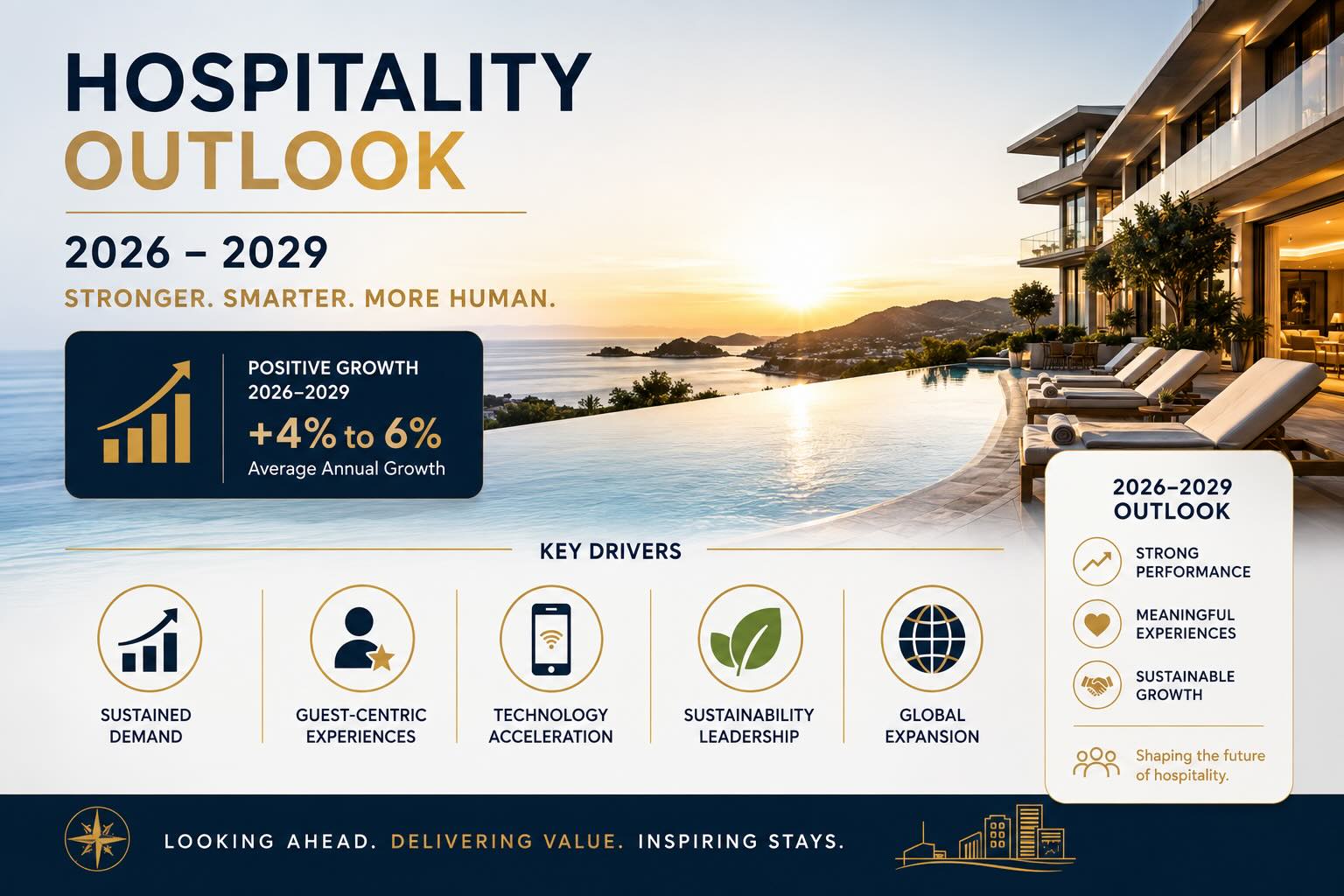
(Trends, Market & Outlook 2026–2029)
In 2026, the hospitality industry enters a decisive new cycle set to reshape the landscape through 2029. With a record contribution of $11.1 trillion to global GDP (according to the WTTC), the sector has definitively moved past the crisis years.
Yet, 2026–2029 marks the end of easy rate-driven euphoria: automatic ADR growth is giving way to a selective, bifurcated market. For owners, operators, and investors, the priority for the next three years is straightforward: how to protect margins and drive sustainable value in a constrained environment?
1. The Market (2026–2029): Hybridization and Polarization
Across this three-year cycle, market growth is no longer uniform. A clear operational Darwinism is taking hold:
- The surge in flexible formats: By 2029, serviced apartments, hybrid hospitality, and managed living will capture a major share of institutional capital. Requiring leaner staffing models, they consistently deliver higher operating margins.
- The resilience of ultra-luxury: Branded residences continue to outperform, mitigating upfront construction costs through private residential pre-sales.
- Europe’s focus on standing assets: Unlike Asia or the Middle East, where greenfield construction dominates, the European market through 2029 will center on renovation, repositioning, and commercial-to-hotel conversions.
2. Key Trends Through 2029: AI, Bleisure, and Hyper-Local Anchoring
Shifting guest profiles are establishing new operational baselines:
- Institutionalized hybrid work: The boundary between business and leisure has dissolved. By 2029, top-performing assets will offer fully modular footprints (coworking hubs by day, activated social and F&B venues by night).
- Embedded, invisible AI: AI is becoming foundational back-office infrastructure. Over the next three years, autonomous revenue management, multilingual AI reservation agents, and predictive energy maintenance will be non-negotiable levers to protect margins.
- Locally anchored guest experiences: In response to chain standardisation, capital will reward concepts with authentic regional grounding (local craftsmanship, farm-to-table F&B, cultural programming).
3. Structural Headwinds for 2026–2029
While international tourist volumes remain robust, operational balance sheets face distinct pressures:
- Wage inflation: Recruiting and retaining skilled talent remains the primary operational friction, squeezing gross operating profits (GOPPAR).
- The refinancing wall: With interest rates anchored higher for longer, refinancing events scheduled between 2026 and 2029 will demand rigorous financial restructuring (and often fresh equity injections).
- Obsolescence risk (the “brown discount”): Thermally inefficient and carbon-intensive assets face sharp valuation markdowns by 2029, alongside heightened risks of restricted debt access.
4. Strategic Outlook: The Repositioning Era
Looking toward 2029, an asset’s valuation will no longer rely solely on its prime address. It will be determined by its capacity to expand Net Operating Income (NOI), its verifiable ESG compliance, and its operational agility. The winners of the 2026–2029 cycle will be sponsors capable of executing targeted Value-Add strategies (deep retrofits, technology integration, spatial hybridization).
The Ormesys Partners Perspective:
Across the 2026–2029 cycle, debt service costs and sustainability mandates are fundamentally rewriting hospitality underwriting. Project success hinges more than ever on tailored financial engineering. Whether restructuring legacy liabilities, structuring debt for major energy retrofits, or advising on strategic disposals, anticipating operational risk is our blueprint for unlocking long-term asset value.